-
-- -
--Airbus may sell stake in submarine supplier Atlas-Die Welt
FRANKFURT Fri Aug 22, 2014 12:57pm EDT
The logo of Airbus Group is seen on the company's headquarters building in Toulouse, February 25, 2014 on the eve of its 2013 annual results presentation.
Credit: Reuters/Regis Duvignau
(Reuters) - Airbus (AIR.PA) is considering a sale of its 49 percent stake in submarine supplier Atlas Elektronik as part of a reshuffle of its military business, German newspaper Die Welt reported on its website on Friday, citing industry sources.
Aerospace and defense group Airbus - then called EADS - and German industrial group ThyssenKrupp (TKAG.DE) jointly bought Atlas Elektronik from BAE Systems (BAES.L) in 2005, beating out France's Thales (TCFP.PA).
Die Welt said Airbus was to make a decision on a sale of its stake in the coming months. ThyssenKrupp likely has a right of first refusal, it said.
Airbus declined to comment and ThyssenKrupp said it would not comment on speculation. Atlas said it was up to its owners to comment on the report.
The news comes only days after Germany's economy minister told the country's arms industry that its future lay in consolidation with European peers, as Berlin becomes more cautious on arms exports.
Atlas Elektronik - which makes a range of products for submarines ranging from combat systems to torpedoes, marine minesweepers and communication systems - generated about a third of its 2013 sales of 441 million euros ($584 million) outside Europe, according to Die Welt.
The paper speculated that Thales could launch a fresh approach if Airbus decided to sell its stake, having lost out in 2005 due to political resistance to a foreign firm becoming part-owner in a German defense business.
While governments and industry agree on the rationale for consolidation in the European defense industry, in practice governments often find deals unpalatable for security or domestic political considerations.
Thales declined to comment on the matter.
($1 = 0.7555 euro)
(Reporting by Maria Sheahan; Additional reporting by Dominique Rodriguez in Paris; Editing by Michael Urquhart)Comment
-
--A350 vs 787 Dreamliner: How they stack up
3:36 PM Wednesday Aug 6, 2014
...
Aviation reporter Grant Bradley has had the pleasure of riding on both the Boeing 787 and the Airbus A350XWB. Which one did he prefer?
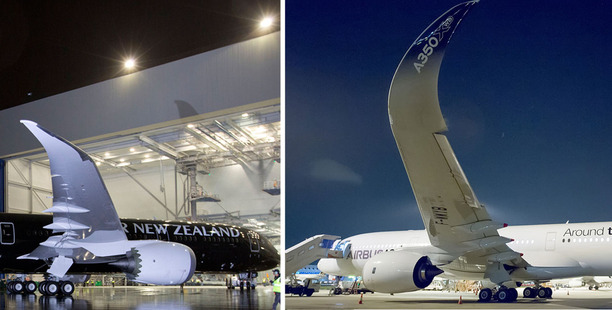
Photo / Brett Phibbs
Aviation reporter Grant Bradley rode on an Auckland-Sydney demonstrator flight of the Boeing 787 Dreamliner two years ago before it had widely entered service and was aboard its new arch-rival, the Airbus A350XWB on the same leg during a route proving tour yesterday.
Here's how some of the features the plane makers promote compare for passengers and for airlines.
The windows
They're one of the first feature passengers notice about the Dreamliner - they're up to 70 per cent bigger than older aircraft and about 30 per cent bigger than its contemporaries.
The A350's windows are larger than any other Airbus model, are wide and but noticeably smaller than the Boeing. Airbus' aircraft interiors marketing manager Stefanie Von Linstow said the
company arrived at the window size after extensive research of what its customers of all nationalities wanted.
The other difference is how passengers in shutting out the light where Boeing's innovation is. The Dreamliner has push button dimmable windows whereas the demonstrator A350 has traditional manual blinds or electro-mechanical shades. Boeing says it saves on maintenance in the long run although there has been criticism of how long they take to dim and just how much light they shut out. Von Linstow says Airbus blinds shut out 100 per cent of light.
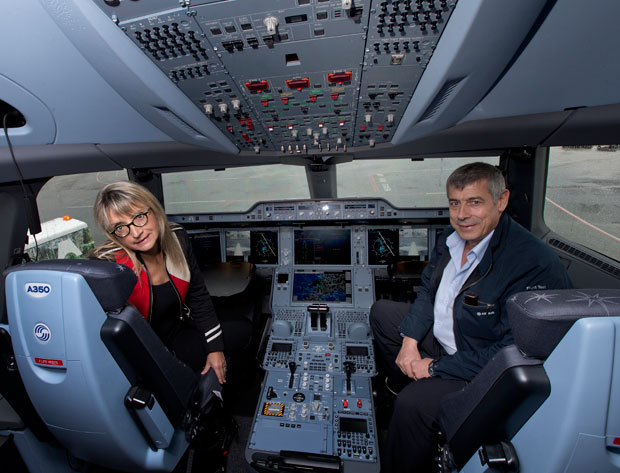
Airbus executive Isabelle Floret with Airbus test pilot Jean Michel Roy, in the cockpit of the Airbus A350 XWB. Photo / Brett Phibbs
High ceilings for that feeling of spaciousness
Hard to separate them here. On the demonstrator flights there weren't any in the centre of the plane in the premium cabins giving a relatively cavernous feel to the cabin. Each airline determines where they put them but are likely to keep them out of business class. Both planes have flatter side walls increasing the sense of spaciousness.
As the XWB tag indicates, the Airbus has an extra wide body, certainly on the inside where it is a few centimetres wider than the Dreamliner. Airbus also has drawn a line on the sand on seat width -- 18 inches; no less. The economy cabin in the Airbus had a 3-3-3 configuration and the seats were fine, the Dreamliner demonstrator had Boeing's ideal eight across cabin -- and those seats were very comfy. However, most of its revenue-hungry customers have opted for the nine-across configuration.
Watch: Inside the new Airbus A350XWB
Video
LED mood lighting taken to a new level
Again both manufacturers have gone for it. Boeing offers 14 standard "scenes" of lighting with numerous different colour variations. Airbus has put a number on it; 15.7 million different colours with an "infinite" number of variations uniquely controllable lengthwise and across the cabins. Both planes were putting them through their paces to show them off on the trial flights.
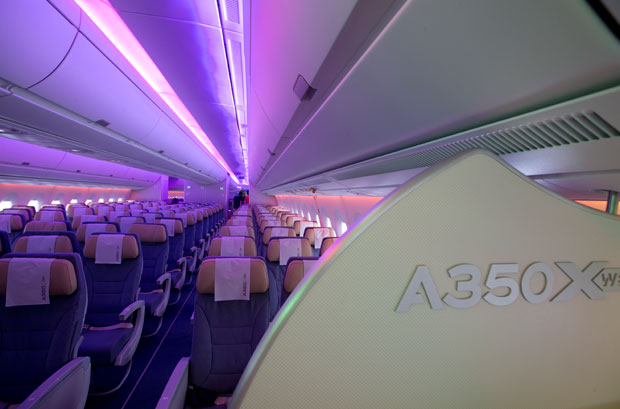
Interior of the A350. Photo / Brett Phibbs
Quieter cabins
New acoustic linings, new engines and aerodynamic wings make the planes quieter than earlier airliners. During the demonstrator flights the Dreamliner was belting its way through thicker air at just 29,000 feet to avoid nasty winds higher up whereas the A350 had a dream run at 39,000 feet and was noticeably quieter.
A more fully furnished sample cabin would also have helped absorb noise. The big Rolls Royce engines have that A380 quiet and calm about them, the only time they really growled was when pilots gave it some welly to climb steeply from 100 feet during a deliberate missed landing at Sydney Airport after a glory tour over the city. Even then the test pilots say the engines had 30 per cent to 40 per cent more thrust to give.

787 Dreamliner Business Class. Photo / Brett Phibbs
Jetlag busting cabins
Both planes make extensive use of stronger carbon fibre fuselages (although Airbus uses more traditional construction techniques) which allow optimised pressure for passenger comfort. Both plane cabins are pressurised to a more comfortable 6000 feet instead of the 8000 foot norm.
Both promote cleaner air through better filtration and more frequent introduction of new air, in the case of Airbus every two to three minutes. Difficult to make a call on this during a three-hour hop across the Tasman but the aviation industry will be looking forward to an independent study of frequent fliers -- crew for example -- on longhaul routes once the planes go head to head in commercial service.
Watch: Inside Air NZ's Dreamliner
 Video
Video
Fuel savings
Besides the price they can negotiate for the aircraft and service package this is the bottom line for airlines whose fuel costs are more than 50 per cent of total expense on some routes. Lighter materials, less hydraulic machinery and cabling make the planes lighter and they're powered by next generation more powerful and more efficient engines.
Boeing boasts of savings of around 20 per cent on comparable older aircraft - a Boeing 767 for example - while Airbus is making even bigger claims; 25 per cent. Its A350 marketing director Mike Bausor said this was based on a comparison with another older Boeing aircraft, a 777-200.
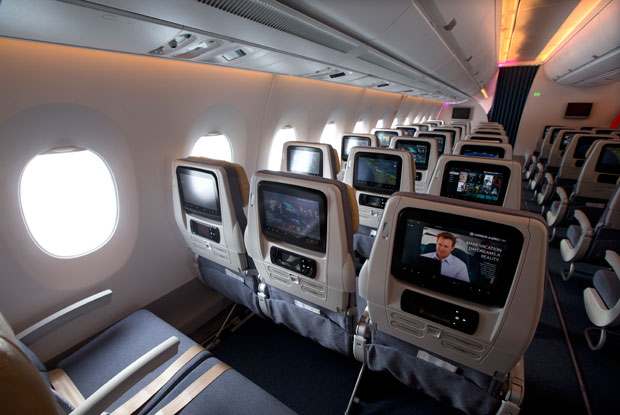
Airbus A350. Photo / Brett Phibbs
While airlines are generally supportive of the Boeing claims it's early days for Airbus whose A350 is due to enter service with Qatar Airways later this year. For passengers fuel savings are good news, competitive pressure for airlines means they'll keep a lid on fares where they have to.
The winner?
It's got to be the passenger, fantastic new widebody planes more comfortable to ride in.
- NZ Herald
Comment
-
-- Grant Bradley
Emirates plans to double super jumbo fleet in high-growth mission
5:00 AM Wednesday Jul 16, 2014
 Emirates says the A380 has allowed it to operate more efficiently.
Emirates is about to put its 50th Airbus A380 into service and plans to almost double its fleet of the super jumbo within the next three years.
While sales of the double decker plane have been sluggish to other airlines, the Dubai-based carrier says it fits its high-growth strategy.
A growth in capacity of 71 per cent since 2010 has cemented Emirates' position as world's largest international airline by passenger kilometres flown.
After the entry of its latest A380 next month, Emirates will offer on a weekly basis 5.7 billion available seat kilometres (ASKMs) to 145 destinations.
Although it has piled on capacity since 2010, including to and from New Zealand, the airline said it had been able to maintain seat load factors of close to 80 per cent.
During the four years, Emirates also added 48 cities to its global destination network.
The airline's president Sir Tim Clark said Emirates had added capacity equivalent to what some mid-sized airlines operate.
"The A380 has helped us serve customer demand on trunk routes, operate more efficiently at slot-constrained airports, and also introduce new concepts on-board."
One congested airport, London's Heathrow, said large aircraft like the A380 freed up slots at the airport by bringing more travellers in and out of the airport in one aircraft.
But other carriers have not been as keen as Emirates to sign up. Sales have been patchy with just 10 already flying the plane which entered service with Singapore Airlines in 2007.
The latest customer to get an A380 planned to display it at this week's Farnborough Air Show but delivery delays forced it to abandon the plan.
Rival planemaker Boeing's latest version of the 747, the 747-8 has also been a slow seller.
Read more by Grant Bradley Email Grant Bradley
Comment
-
--New Airbus arrives in Auckland + video
5:30 AM Wednesday Aug 6, 2014
Airbus' technical and sales machine touched down in Auckland last night aboard the world's newest airliner.
The Airbus A350XWB is the French-based plane maker's latest entry in the "war of the widebodies" and is taking on rival Boeing's Dreamliner and 777s and landed following a flight from Sydney
.
While the Airbus plane is on the final stages of a world tour to prove it is technically fit to enter service later this year, it has a high level sales force were among the 60 on board to spread the word to committed or potential customers.
Air New Zealand is a possible customer and has said it could look at the $340 million plane later this decade, but only after it has got its full order of Boeing 787-9 Dreamliners, the first of which will start scheduled passenger services at the weekend to Australia.
Some Air New Zealand staff will look over the plane today before it flies on to Santiago, Chile at 3pm.
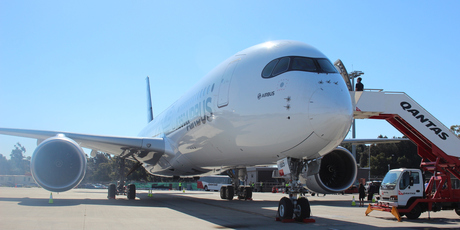 An Airbus A350XWB.
Both planes boast many of the same features -- extensive use of lightweight carbon fibre materials and titanium, more comfortable cabin pressure and many variations of mood lighting throughout the cabin. The A350 that landed about 7.30pm had a sample cabin provided by Airbus, which has 742 orders for the plane.
However, the development of the Airbus started several years after the Boeing and the French company has refined several of the systems Airbus A350 marketing director Mike Bausor said the Airbus was more expensive than its nearest Boeing rival because it was a bigger plane.
• Grant Bradley travelled courtesy of Airbus
Comment
-
-- Grant Bradley
Emirates gets its 50th A380 + video
10:50 AM Thursday Aug 21, 2014
27CDB6E-AE6D-11cf-96B8-444553540000" codebase="http://download.macromedia.com/pub/shockwave/cabs/flash/swflash.cab#version=9,0,47,0">
Emirates has released footage of Airbus workers building one of their 50 A380 super jumbos, a task that takes 800 workers 65 to 80 days to assemble, install, test, paint, furnish and deliver.
While other airlines have been slow to sign up for the double decker aircraft, they form the backbone of the Emirates fleet and it has another 90 on order to soon be flying through its Dubai hub.
All of Emirates' A380s have been furnished and delivered from the Airbus facility in Hamburg, Germany.
First, the aircraft fuselage is produced in Hamburg and then transported to Toulouse for the first stage of final assembly.
The wing sections, produced in Britain, are also shipped from the Airbus Hamburg facility to Toulouse, France.
Parts such as the fuselage and wings are transferred through a transportation network that includes three specially-commissioned ships to carry the sections from production sites throughout Europe.
Over 10,000 bolts are used to connect the fuselage and over 4000 for the wings.
The first part of final assembly, which takes place in Toulouse, results in an aircraft that is ready for its first "ferry flight", minus its interior and paint.
After assembly, each of the five sections of the fuselage are tested by engineers, and then the aircraft is off to Hamburg for painting and cabin furnishing. It takes 30 people approximately 10 days to paint the A380, which has a surface area of 3150sqm - approximately the size of seven professional basketball courts. Over 500kg of paint is needed just to give the aircraft its white colour.
Cabin furnishings are installed in the final stages of the assembly process. It takes about 33 working days to furnish the 550sqm cabin area on-board the Emirates A380.
This includes all seats, galleys, crew rest areas, the unique shower-spa and private suites in first class, the on-board lounge located at the back of the Business Class cabin, and inflight entertainment system in all cabins.
Emirates took deliver of 13 of the giant double-decker aircraft last year.
More than 28 million passengers have travelled on the Emirates A380 over the last six years of operations.
Airbus' A380 has 318 orders, with the company delivering 138 planes, since 2005.
The Seattle Times reported this week that because of the A380's slow sales, Airbus has cut the list price of US$400 million by as much as 50 per cent in some cases to try and close deals for the massive jet.
The Emirates A380
• Total number of passenger seats (Emirates has two A380 configurations) 489 / 517
• Number of A380s in Emirates fleet to date: 50
• Number of A380s pending delivery: 90
• The shortest flight on an Emirates A380: Dubai-Kuwait, 851km, 1hrs 45mins. This is also the world's shortest A380 route.
• The longest flight on an Emirates A380: Dubai-Los Angeles, 13,414km, 16hrs 20mins.
• Number of bottles of wine on board a typical Emirates A380 flight: 478
• Number of bottles of champagne on board a typical Emirates A380 flight: 31
• Number of bread rolls loaded onto an A380: 650 for all three classes
• Number of croissants on board an A380: Up to 550 for all three classes
• Number of main courses served on an A380: Approximately 515 for all classes
• Number of desserts served on an A380: Approximately 450 for all classes
• Number of sandwiches loaded for the A380 onboard lounge bar: Almost 80 sandwiches
• Amount of liquid soap loaded on Emirates A380 flight to Heathrow: 12 litres of liquid soap distributed in 15 toilets
• Volume of water that the aircraft holds to facilitate the showers: 2267 litres
• Average number of crew aboard each A380 flight (ultra- long haul flights)4 flight deck crew, 24 cabin crew, 2 cabin service attendants
- NZ Herald
Comment
-
--daily news
Added on September 4, 2014 09:40 am
Airbus to produce Super Puma MK1 helicopters in Romania
by Romania Insider
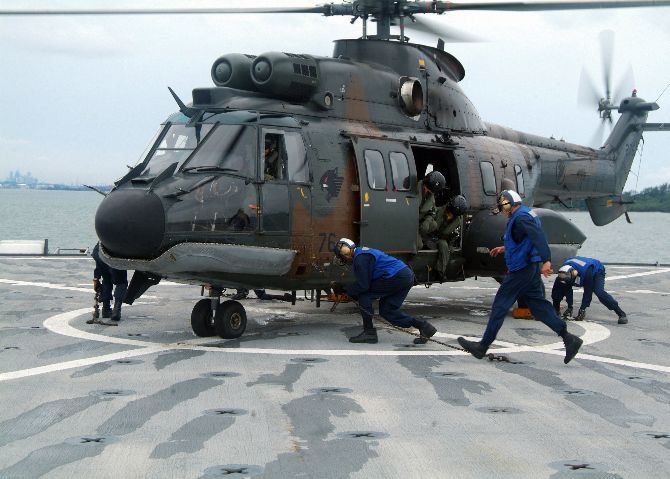
Airbus Helicopters will produce starting most likely next year Super Puma MK1 helicopters in Romania, at Ghimbva, close to the central city of Brasov.
Romanian Economy Minister Constantin Nita and the Airbus CEO Guillaume Faury recently signed a memorandum of understanding to this end. Some of the production in Romania could end up being used in Romania, as the Army, as well as the Defense and Domestic Affairs Ministry need to modernize their helicopter fleets.
“I believe a product made in Romania with high end technology is an objective for these ministries,” said Prime Minister Victor Ponta, who also attended the signing ceremony. Airbus made Puma and Alouette helicopters in Romania in the 70s under license.
IAR Brasov, a company controlled by the state, has offered Airbus Helicopters’ Romanian company Vadstena a 15,000 – sqm plot, where the foreign company will build a production hall for the new line. The new investment and production line will bring know how to Romania, jobs and will help increase the local economy’s competitiveness by exporting.
EADS’s Premium Aerotec inaugurates EUR 40 mln Airbus component factory in Romania
Premium Aerotec starts production of Airbus aircraft components in Romania
editor@romania-insider.com
(photo source: Wikipedia)Comment
-
--Airbus gross orders pass 1,000 in August
By: David Kaminski-Morrow
London
Source:
Airbus’s gross orders for the year have topped the four-figure mark, although activity was relatively quiet during August.
Iberia’s order for eight A350-900s accounted for the only long-haul deal, while there were firmed agreements covering 13 single-aisle aircraft.
Airbus’s backlog data for August shows Chinese lessor CALC took four A320s while Greek carrier Aegean Airlines cemented its agreement for another pair.
AirAsia converted four more A320s to the re-engined A320neo variant.
These helped push gross orders to 1,001 for the first eight months of 2014, although cancellations and conversions resulted in a net figure of 722.
Airbus delivered 389 aircraft over the period – including 17 A380s – slightly down on the 394 achieved by the same point last year.
Boeing had taken net orders for 918 aircraft to 26 August and had already reached 400 deliveries by the end of July.Comment
-
--Giant Airbus A380 finds sales not so big
The A380 has a list price of $400 million, but Airbus has cut prices as much as 50 percent. So far, Airbus has received 318 orders and delivered 138 planes to just 11 airlines — a disappointing tally given forecasts that the plane would be a flagship aircraft for carriers worldwide.
By JAD MOUAWAD

 Noah Seelam / AFP/Getty Images
An Emirates Airbus A380, the world's largest passenger airliner, is seen earlier this year at an air show in Hyderabad, India.
Related- Sanctioned Aeroflot unit wants more 737s from Boeing
- Boeing says July brought most orders ever for any month
- Boeing sets sights on profit from junked jets
- Boeing defense chief sees BCA ties as a key advantage
@ebbuk "Quacking?" When did ducks begin to wear shoes? (August 17, 2014) MORE
obtuse errbus business management along with the need to make the biggest aircraft........has met its match......again.... (August 17, 2014) MORE
Rewriting history. Airbus invented big twins in the seventies, competing 707s, DC10s, L1011. The 767 came a decade... (August 18, 2014) MORE
To get a sense of the Airbus A380’s size and ambition, walk up the grand staircase of an Emirates version of the aircraft, go past the showers and the first-class suites, then pass by endless rows in business class to reach the bar at the back of the upper deck
This sleek semicircle, alluringly underlit and fully stocked with pricey spirits like Grey Goose vodka, is undoubtedly one of the defining features of this aircraft, which can hold more than 500 passengers. The plane dwarfs every commercial jet in the skies.
Since it started flying commercially seven years ago, the A380 has caught the imagination of travelers. Its two full-length decks total 6,000 square feet, 50 percent more than the original jumbo jet, the Boeing 747. Its wingspan barely fits inside a football field.
Its four engines take this 560-ton airplane to a cruising altitude of 39,000 feet in less than 15 minutes, a surprisingly smooth ascent for such a bulky plane. Passengers love it because it’s quiet and more reminiscent of a cruise ship than an airplane.
The A380 was also Airbus’ answer to a problematic trend: More and more passengers meant more flights and increasingly congested tarmacs. Airbus figured the future of air travel belonged to big planes flying between major hubs.
“More than simply a big airplane,” one industry analyst wrote when the first A380 was delivered to Singapore Airlines in 2007, “the newest industry flagship will change forever the way the industry operates.”
The prediction hasn’t exactly come true.
Airbus has struggled to sell the planes. Orders have been slow, and not a single buyer has been found in the United States, South America, Africa or India. Only one airline in China has ordered it, and its only customer in Japan has canceled. Even existing customers are paring down orders.
The A380 has a list price of $400 million, but the pressure has forced Airbus to cut prices as much as 50 percent, according to industry analysts. So far, Airbus has received 318 orders and delivered 138 planes to just 11 airlines — a disappointing tally given forecasts that the plane would be a flagship aircraft for carriers worldwide.
Only Emirates has made the A380 a central element of its global strategy, ordering 140 as it built a major hub in Dubai. But Emirates is unique. No one else has bet on the plane with quite the same confidence.
The A380 hasn’t done so well for a number of reasons, some merely cyclical. The plane was introduced amid a deep downturn in the airline business. Airline executives were wary of expanding their fleets aggressively, especially for a costly, four-engine fuel hog.
But critics like Richard Aboulafia, an aerospace analyst at the Teal Group, an aviation-consulting firm in Fairfax, Va., say the main problem is more fundamental: Airbus made the wrong prediction about travel preferences.
He said people would rather take direct flights on smaller airplanes than get on big ones — no matter their feats of engineering — that make connections through huge hubs.
“It’s a commercial disaster,” Aboulafia says. “Every conceivably bad idea that anyone’s ever had about the aviation industry is embodied in this airplane.”
Airbus spent roughly $25 billion to develop the aircraft. The A380 was delayed for years because of manufacturing problems while Airbus struggled to keep the weight down and coordinate its complex design among dozens of suppliers across Europe.
In 2012, Airbus discovered small cracks in supporting ribs inside the wings, an embarrassing and costly design error being corrected.
While the A380 program has been a boon for the European aerospace industry, Airbus is unlikely to recover its research-and-development costs. The best it can expect is to break even on production costs, according to analysts, provided that it can keep orders going.
Steven Udvar-Hazy, chief executive of the Air Lease Corp., which leases aircraft, calls the lack of interest in the planes “a very unusual situation,” especially among U.S. airlines. “I’ve never seen this before in a big program,” he says.
Competing conclusions
A little more than a decade ago, Boeing and Airbus looked at where their businesses were headed and saw similar facts: air traffic doubling every 15 years and estimates that the number of travelers would hit 4 billion by 2030. They came to radically different conclusions about what those numbers meant for their future.
Boeing figured traffic would move away from big hubs and toward secondary airports. So it started to build a smaller, more fuel-efficient long-range aircraft, which became known as the 787 Dreamliner.
Airbus, on the other hand, saw the rise of international traffic through major hubs and decided to bet on a big plane to connect those big airports.
“The A380 is not made for every route, but it is ideal for high-traffic routes, high-volume routes that are congested or where there are flying constraints,” says Antonio Da Costa, Airbus’ head of A380 marketing.
And there are a fair number of those routes. Around 15 of the 20 largest long-haul routes by passenger volume in the world today are slot-constrained, meaning they face some restrictions on the number of daily takeoff or landings, says John E. Thomas, managing director at LEK Consulting, a transportation-advisory firm.
Here is one example of how the Airbus theory works in practice: This summer, British Airways plans to replace three Boeing 747s flying each day between London and Los Angeles with two A380s, freeing one slot at Heathrow Airport for another flight.
Yet despite the congestion at hubs like Heathrow and the growth of megacities like New York, New Delhi and Beijing, the market for large planes remains small.
Airbus predicts that in the next 20 years, airlines will order more than 29,000 planes from Airbus, Boeing and other makers. But the bulk of those, or roughly 20,000, will be smaller, single-aisle planes that fly routes like New York to Chicago, or London to Frankfurt, Germany.
Airbus estimates that the market for the biggest long-range airplanes will be about 1,700.
Boeing, too, is facing lukewarm demand for its latest jumbo-jet upgrade, the 747-8. It has received just 51 orders for this big plane, which can seat about 460 passengers and lists at $357 million.
By contrast, it has sold more than 1,200 twin-engine 777s, which sell for as much as $320 million. (Airlines typically get discounts on the listed prices.)
More worrisome for Airbus is that it has struggled to find new customers for the A380 after a flurry of initial orders. Just three new carriers — Etihad Airways, Qatar Airways and Asiana Airlines — are getting A380 planes this year.
And last month, Airbus canceled an order for six A380s destined for Skymark Airlines, a low-cost carrier in Japan that has been losing money.
Garuda of Indonesia recently dropped plans to buy the A380, deciding that the plane was too big for its markets.
And Virgin Atlantic, which has options for six A380s, remains undecided about whether to proceed. The airline was partly acquired by Delta Air Lines in 2012; Delta CEO Richard Anderson has said the A380 is “by definition an uneconomic airplane unless you’re a state-owned enterprise with subsidies.”
Current customers, too, are cutting back their orders, including the major carriers in France and Germany, where the plane is assembled. Air France postponed the last two of 12 planes it had ordered. Lufthansa has scaled back its order to 14 from 17.
Bruno Delile, Air France’s senior vice president for fleet management, says there are a limited number of routes in its network with enough daily traffic to justify the expense of such a big plane.
“The forecasts about traffic growth and market saturation haven’t exactly panned out,” he says.
Airlines also have to gain the cooperation of airports to modify gates and widen taxiways to make room for the plane. Apart from the main global hubs, few airports have made these investments.
No airport in Brazil, for instance, can handle an A380. The plane was only recently allowed in Mumbai
.
“Airports haven’t really been rushing to welcome the A380,” Delile says.
Bad timing
Airbus may have mistimed the market in a more fundamental way. While European engineers were developing the plane, their counterparts at Boeing were working on alternative designs. Out of this effort came the Dreamliner, with a carbon-composite fuselage, a host of electronic systems and more efficient engines that could fly longer distances while consuming less fuel.
That 787, which entered service in late 2011, had its share of high-profile problems; the entire fleet was grounded for three months in 2013 because of battery fires. Boeing says the problem has been resolved, and the company has orders for more than 1,000.
With versions that seat 210 to 330 passengers, and with a range of about 9,000 miles, the 787 allows airlines to fly pretty much anywhere in the world and connect smaller airports without going through a hub.
Japanese carriers are flying these planes from Tokyo to Düsseldorf, Germany, and to San Diego and Boston. This reduces the need for bigger planes to feed big hubs. And passengers are willing to pay more to avoid a connection, says Will Horton, an aviation analyst at CAPA — Centre for Aviation.
Recognizing the success of the 787, Airbus started developing its own version, the A350-XWB. The first should be delivered to Qatar Airways before year-end. Airlines have ordered 742 of the A350s since the program was announced in 2006.
“No doubt some airlines, given the opportunity to rewrite history, would not order the A380,” Horton says.
Unlike airlines in the United States, Emirates, which is a product of Dubai’s aviation-friendly policies, operates from a single hub. The airport handled 66 million passengers last year, rivaling Heathrow as the busiest international hub. Emirates serves more than 140 destinations, essentially connecting flows of passengers with a single stop in Dubai.
But for Emirates, the biggest selling point of the A380 is its ability to pack in more business-class seats and create an environment that appeals to big-spending passengers.
“The upper deck of the A380 is an absolute gold mine for us,” says Emirates’ President Tim Clark. “We elected to make it all premium. We elected to put in all the gadgets and gizmos. We were laughed at, at first.”
There are more first- and business-class seats on the Emirates A380 than on the 777, and they are usually 75 to 80 percent full, Clark says. On some routes, like those to Heathrow, where Emirates has five daily flights, that figure can reach 90 percent.
Once the whole plane is 85 percent full, its operating costs fall below those of a 777, he says.
Looking for buyers
It’s a simple-enough recipe. But for the plane to be successful for Airbus, Emirates can’t be the only airline to make it work.
“United would be a great operator from San Francisco to Asia,” says Mark Lapidus, chief executive of Amedeo, an aircraft-leasing company. Last year, Lapidus announced his company would buy 20 new A380s, in a deal valued at $8.3 billion, then lease them to airlines. It was an expensive gamble, and Amedeo doesn’t have any commitments yet.
The problem is that U.S. carriers aren’t interested. Wall Street analysts aren’t convinced, either. Shares of United would plunge at least 10 percent if it bought A380s, according to one analyst, because of concerns that they would bring too much capacity into the market.
In recent years, U.S. airlines have found the way back to profitability by cutting capacity and retiring airplanes, effectively taking seats out of the market.
A bigger plane, in the view of some analysts, would undo everything they’ve done.
Some analysts are also worried about the resale value of an A380, once the planes come off their lease and enter the secondary market. With weak sales and limited interest today, aviation experts say, the plane’s resale value could potentially depress new A380 prices even further.
In his aerie in Dubai, Emirates President Tim Clark appears untroubled. He has repeatedly said he would buy more planes if Airbus could deliver them fast enough.
“My view is that we’ve all got to tough this out,” he says. “As I say to my friends at Airbus: ‘Don’t bottle this. The day will come again. The global economy will take care of you.’ ”
He has encouraged Airbus to build an even bigger version of the A380. That, even Airbus would concede, seems unlikely.Comment
-
--Boeing 787 and Airbus A350: A Tale of Two Planes
By Eshna Basu | More Articles
August 31, 2014
The two biggies of aviation, Boeing (NYSE: BA ) and Airbus (NASDAQOTH: EADSY ) . are always trying to outdo each other in the battle of innovation. Their rivalry has been so aggressive that it's even led to a nasty war of words. One such epic clash involves the revolutionary Boeing 787 and the groundbreaking Airbus A350. These aircraft are the companies' built-from-scratch models -- a point of both pride and trouble for the two. Here's the story of the evolution of these iconic jets, and a look into their future prospects.
Sowing the seeds
Boeing warmed up to the idea of building an innovative aircraft with bleeding-edge technology in the early 1990s when it was looking to replace the aging 767. Ideas included making a "Sonic Cruiser" that would feature enhanced cruising speed, or engineering a larger version of the 747. But neither materialized -- there was lukewarm response for an upgraded 747, and after fuel prices began escalating, airlines shifted focus from higher speed to greater fuel efficiency.
Finally in 2003, the American major initiated talks about developing a carbon-composite plane that would consume less fuel. In 2004, Boeing took the wraps off the 787 Dreamliner, and ended the year with an order for 50 of the aircraft from launch customer All Nippon Airways of Japan.

All Nippon Airways Boeing 787-8, Source: Wikimedia Commons.
The 787, as a direct competitor to the Airbus A330, pushed the European airplane maker to come up with a rival offering and prevent Boeing from encroaching on its territory. With continued pressure from customers, Airbus eventually gave commitment to develop an all-new aircraft; its board officially branded it the A350 program in December 2004. However, the program faced severe criticism from customers, and sensing dissatisfaction, Airbus announced the A350 XWB (extra wide-body) in 2006 with three variants: the A350-800, -900, and -1000.
Plagued by unending problems
Creation of the 787 and the A350 were bold steps undertaken by the aviation stalwarts. The two aircraft have been the duo's attempt at building technologically advanced machines, answering airlines' call for higher fuel efficiency in aircraft that provide an enhanced travel experience. While the intentions were good, both Boeing and Airbus have experienced numerous issues with the clean-slate aircraft.
The A350 family was originally slated to enter service in 2010, but alterations such as a wider fuselage and fresh engines pushed the scheduled to 2013. In 2012, after facing production challenges, the date was extended again to the second half of 2014. Also, while Airbus had conservatively estimated a development cost of $4.17 billion (3.5 billion euro) in 2005, it now stands at roughly $15 billion.

Airbus A350-941 XWB, Source: Wikimedia Commons.
Boeing has reeled under Dreamliner hitches, too. In the development stage, the company faced numerous technical and production challenges that delayed delivery. The aero major outsourced work to save on time and cost, but ended up running three years behind the original schedule of 2008 and overshooting the budget by billions. The project development cost stands at a massive $32 billion, compared with the initial estimate of $6 billion. Even after entering service in 2011, the Dreamliner has been plagued with technical snags, including engine failure, cockpit cracks, and battery problems.
Dreamliner's showdown with the A350
Boeing is ironing out production glitches as Airbus prepares the A350 for its first commercial flight this year. The weeklong Farnborough air show in July clearly displayed airlines' hunger for wide-bodies, and Boeing grabbed the opportunity to display the 787-9 model. Boeing had delivered 162 Dreamliners through the second quarter of 2014, and the model's share of total deliveries is gradually increasing:
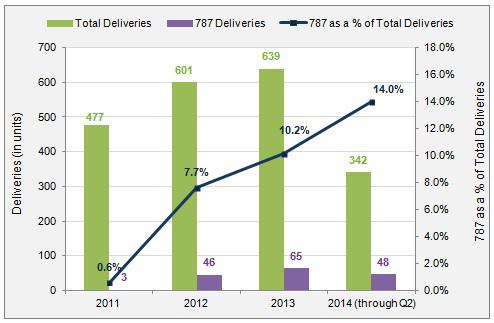
787 Dreamliner deliveries, chart by author. Data source: Bloomberg, and Boeing (link opens a pdf).
The unique selling point of both 787 and A350 is light carbon fiber, where Airbus tops with 53% of the airframe made of the super-light material, while the 787 has 50%. The rivals have also stressed passenger comfort with their jets. The A350's cabin space is 13 centimeters wider than the 787, but the 787's windows are noticeably bigger. To make the interior look roomier, the companies have kept the jets' side walls flat.
Airbus has received 742 total orders for A350s through July, compared with Boeing's solid backlog of 869 787s at the end of second quarter. The 787 currently has a production rate of 10 per month. Boeing plans to augment that to 14 a month by 2020; it is being supported by expanding production capacity from 787 composite wing box maker Mitsubishi Heavy Industries. In contrast, Airbus expects to reach the 10-per-month production rate by 2018. Airbus CEO Fabrice Brégier is optimistic about the A350 XWB program, saying that if everything remains on track, the jet can make for "40 percent of our revenue, probably for a minimum of 20 to 30 years."
The crux
The 787 and A350 are exemplary creations from the aerospace behemoths. It's true that two have faced hiccups time and again, but then they aren't derivative planes. With an early entry, the 787 definitely has a head start, but the A350 is a strong offering that could make up that time gap. The overall aviation market outlook is quite upbeat and could accommodate both jets, helping Boeing and Airbus reach their goals.Comment
-
--Parts for 200th aircraft reach Airbus China assembly line- Xinhua
- 2014-09-05
- 14:28 (GMT+8)

Staff inspect the A320 parts arriving at the Tianjin Assembly Line, Sept. 2. (Photo/Xinhua)
The Airbus assembly line in north China's Tianjin has received parts for the 200th A320 family aircraft, which will be delivered to China Eastern Airlines in December, Airbus said Tuesday.
Sections including the forward and aft fuselage, horizontal and vertical tail, main landing gear doors, inner flaps and engine pylons reached the A320 Family Final Assembly Line China in Tianjin on Tuesday.
Those parts and components were produced at different Airbus sites in Europe and carried by a commercial cargo vessel from Hamburg to Tianjin, Airbus said.
The wings for the A320 Family aircraft assembled at the Tianjin assembly line are locally produced in Tianjin by Airbus's partner Xi'an Aircraft Industry (Group) Company, while the engines will arrive at a later date directly from the engine supplier.
The final assembly line in China is a joint venture between Airbus and a Chinese consortium including the Tianjin Free Trade Zone and China Aviation Industry Corporation.
It started operations in Aug. 2008, assembling A319 and A320 aircraft. So far, a total of 186 A320 family aircraft have been delivered from Tianjin.Comment
-
--Airbus rejects any blame for deadly 2007 crash in Brazil
Published September 01, 2014
Airbus has refused to take any responsibility for the greatest air tragedy in Brazil's history, the July 2007 crash of a TAM jetliner that left 199 people dead, one of Brazil's leading newspapers said Monday.
Attorneys representing the European aircraft maker said in a Brazilian court filing that blame for the disaster at Sao Paulo's Congonhas Airport lies with the cockpit crew, the airline and the poor state of the runway, Folha de Sao Paulo said.
This is the first time that Airbus has blamed the other parties involved, including TAM, its most important client in Latin America.
An Airbus A-320 operated by TAM on a rainy afternoon failed to stop when it landed at Congonhas and went off the runway, out of the airport, across a street and burst into flames against a warehouse.
All 187 people aboard the plane were killed, along with a dozen people on the ground.
The runway, which was undergoing renovations, lacked grooves to shunt the water from its surface in rainy weather, Brazilian authorities said.
Airbus was responding to a lawsuit in Brazil, according to Folha, for 350 million reais ($156.2 million) brought by Itau Seguros, TAM's insurer and the company responsible for paying compensation for the tragedy.
"The pilots, according to the aircraft maker, did not use the correct procedures for an airplane with an inoperable aerodynamic brake, as was the case of the A-320 that day," said the article in the Brazilian daily.
"All the factors, such as failure to comply with landing procedures, problems at Congonhas Airport and of Brazilian civil aviation, contributed directly and significantly to the accident having the dimension that it did," law firm Levy&Salomon said in its brief on behalf of Airbus.
Brazil's Federal Police said in 2009 that not only was the aerodynamic brake not working while the plane was landing, but that the pilot, Capt. Kleber Lima, left a speed control lever in the position of acceleration and not in the braking position.
The Brazilian air force, for its part, found no proof that the pilots were responsible for problems with the aerodynamic brake.
Infraero, which runs the airports, according to Folha, "was the only one to refute the accusation of Airbus, arguing that the runway at Congonhas was and is in good condition." EFE
Comment
-
--Airbus wins 1,001 gross plane orders in Jan-Aug
PARIS Thu Sep 4, 2014 10:21am BST
The Airbus A350 XWB flight-test aircraft is seen during a media day event at Guarulhos airport in Sao Paulo August 7, 2014.
Credit: Reuters/Paulo Whitaker
(Reuters) - European planemaker Airbus (AIR.PA) said on Thursday that it won 1,001 gross plane orders in the first eight months of the year.
Taking cancellations into account, net orders totalled 722 aircraft through August.
Airbus added that it delivered 389 planes in the period, including 17 A380 superjumbo aircraft.
(Reporting by James Regan; Editing by Blaise Robinson)Comment

- If this is your first visit, you will need to to register before you can post or use the model collection system.: click the register link above to proceed.
 Tweet
Tweet
Comment